
ICL Surgery2025-11-14T23:31:52+13:00

When LASIK isn’t suitable, ICL may be an option in Melbourne

Learn how this implantable lens works inside the eye to help reduce the need for glasses or contacts in some cases

When LASIK isn’t suitable, ICL may be an option in Melbourne

Learn how this implantable lens works inside the eye to help reduce the need for glasses or contacts in some cases

With ICL surgery, many can reduce their dependence on glasses or contacts

Quickly learn how this lens-based vision treatment works and what to expect before, during, and after the procedure
  • ICL surgery may be suitable for people with high levels of short-sightedness, long-sightedness, or astigmatism, especially if the cornea is not ideal for laser procedures such as LASIK or PRK.
  • Candidates are usually over 18, have stable vision, and have healthy eyes with no history of conditions such as glaucoma, iritis, or diabetic retinopathy.
  • During your assessment, detailed measurements are taken to design a custom-made lens that matches your prescription.
  • Your ophthalmologist will review your eye health, lifestyle needs, and expectations to determine if ICL is an appropriate option. All risks, benefits, and alternatives are discussed at your consultation.
  • The Implantable Collamer Lens is a soft, clear lens placed inside the eye to help correct vision.
  • It sits behind the iris and in front of your natural lens, where it cannot be felt.
  • During the procedure, the lens is folded, inserted through a small opening, and carefully positioned to match your prescription.
  • Unlike a contact lens, it stays in place without daily care.
  • The ICL does not replace your natural lens and can be removed if needed.
  • Its design aims to provide clear vision for suitable candidates with high prescriptions or corneas not suited to laser surgery.
  • ICL surgery offers several advantages, including the ability to correct high prescriptions without removing corneal tissue and the option to remove or replace the lens in the future1https://www.webmd.com/eye-health/what-to-know-icl-surgery.
  • Many people appreciate that the ICL is not felt once placed and requires no daily maintenance.
  • However, disadvantages include the need for a surgical procedure inside the eye, potential risks such as cataract formation, and the possibility of needing future adjustments.
  • Patients also require ongoing eye checks to monitor eye pressure and lens position.
  • Your ophthalmologist will help weigh these benefits and considerations to determine if ICL is the right choice for you.
  • ICL surgery is considered a well-established procedure, but, like all eye surgeries, it carries potential risks.
  • These may include infection, inflammation, cataract development, raised eye pressure, or the need for additional surgery to adjust or remove the lens.
  • Some risks are rare and can often be managed when detected early.
  • Before proceeding, your ophthalmologist will explain all known risks, their likelihood, and the steps taken to reduce them.
  • A thorough examination helps determine whether ICL is suitable for your eyes and whether an alternative treatment may be safer or more appropriate for your needs.
  • ICL surgery takes place in a Day Procedure Centre. After admission, you’ll meet your anaesthetist, who provides sedation to help you feel relaxed.
  • Anaesthetic drops numb your eye, and a small instrument gently keeps your eyelids open.
  • The customised lens is folded and inserted through a tiny opening, where it unfolds and is positioned behind the iris.
  • You may see bright lights but not the details of the procedure.
  • Stitches are usually not required. The procedure takes 20–30 minutes, and you will need someone to take you home.
  • If both eyes are treated, surgery is usually one week apart.
  • Results vary, but many suitable candidates experience reduced reliance on glasses or contacts after ICL surgery.
  • Vision often improves shortly after the procedure, with clearer and more stable focus developing as the eye heals.
  • Because the ICL is custom-made, it is designed to match your prescription precisely.
  • Some people may still need glasses in certain situations, depending on their eyes and age.
  • Regular follow-up visits help ensure the lens remains well-positioned and the eye stays healthy.
  • Your surgeon will discuss realistic expectations and long-term care before you decide on treatment.

Clearer vision in 3 simple steps

From your first assessment to life after treatment, we’ve made the journey as straightforward as can be

Step 1: GET IN TOUCH

Not everyone is suitable for laser vision correction. The first step is to find out if treatment could help you. Call our friendly team or use our online calendar to book a free appointment.
Step 2: WE’LL MEET

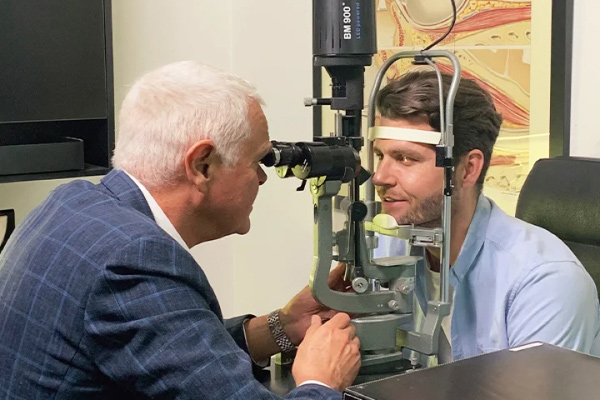
At your appointment, we’ll examine your eyes, answer your questions, and give you an honest recommendation based on your needs. You’ll leave with a clear understanding of the best options for you.

Step 3: ENJOY THE BENEFITS

After treatment, many people are surprised at how quickly daily life becomes easier. From driving to travelling to enjoying sport, you could experience freedom without glasses or contacts.

Freedom from glasses can start with one appointment

Find out if laser eye surgery is right for you

Book your free laser eye assessment and learn if clearer vision is within your reach

Get your questions answered about laser eye surgery in Melbourne

Explore expert insights and quick guides to help you understand treatment options, benefits, and what to expect right here in Melbourne

Ready for life without glasses?

Ready for life without glasses?

Take our 2-minute quiz to see if laser eye surgery could suit you

Hi, I’m Dr Rick Wolfe.

I’ve been performing laser vision correction and cataract surgery in Melbourne since 1991, with more than 30,000 procedures completed.

As a Fellow of RANZCO, I’ve dedicated my career to advancing eye surgery techniques in Australia and internationally.

I regularly share my knowledge at global conferences and founded the World College of Refractive Surgery and Visual Sciences to support excellence in our field.

My goal is simple: to provide safe, precise, and personalised care that helps people enjoy clearer vision.

Every patient is unique, and I take pride in tailoring treatment to individual needs.

Dr Rick Wolfe

Owner, Founder and Surgeon at Vista Eyes Laser Eye Clinic
Ophthalmologist and Laser Eye Surgeon, MB BS, FRANZCO, FWCRS

Go to Top